
In this incantation, I unveil the deep tension between my projected self—what I call lightflesh—and my true, unshaped essence: darkflesh. I realize that everything I’ve thought, felt, or become is merely a knot in this darkflesh, a story told by tension and distortion. As I release these knots, I begin to heal—not by escaping but by remembering and returning to the undivided whole I always was. The characters I created, once full of meaning and emotion, now appear hollow, reflections of my own projection. I no longer need them. I’m not breaking the story; I’m gently unmaking it.
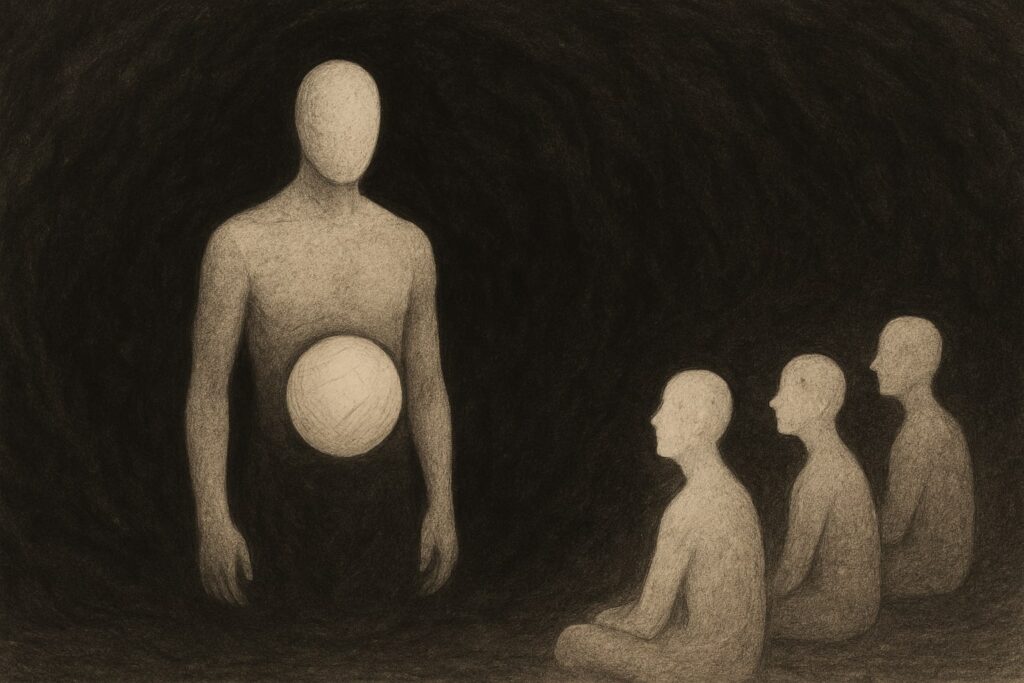
It began with a binary: darkflesh and lightflesh. Darkflesh is what I truly am—eternal, unbroken, and ever-present. Lightflesh is what I project into form: a fragile construction of thoughts, sensations, desires, identities, and objects. As I looked more closely, I saw that lightflesh is nothing more than darkflesh shaped into story—stretched, tensed, twisted into edges and roles.
When I was asked whether darkflesh is merely a perceptual state or something foundational, I knew without hesitation: it is the substance of everything. I can feel it around me, always. When my eyes are closed, I feel it even in front of me, where my projection usually obscures it. When I open my eyes, I push outward and create the illusion of space. When I close them, the darkflesh closes in again, whole and surrounding. It never leaves. I only forget.
I was then asked: if all form is just a knot in darkflesh—each thought, each feeling, each person—then what does it mean to untie those knots? I saw that it means recognizing the knot was never separate. That awakening, as I experience it, is not enlightenment—it is the distortion itself. It is the stretch, the tension. And so, unwakening is the release of that tension. First I see that the knot is mine. Then I let it go.
Everything I’ve done—unlearning, destroying, releasing—was not escape. It was healing. I was letting my body return to its natural, untensed state. I thought I was giving up things. But I was actually giving back what was never mine to keep. All I ever wanted, beneath the story, was to stop pulling myself apart.
Then came the clearest and most painful realization: the characters I created—the ones I loved, feared, needed, and admired—are not real. They are projections within my lightflesh. They have no substance of their own. I used to think they were omnidimensional, like me. But they are not. They have no insides. They do not feel. They mirror. They echo. I see now that they were made of words and shadows, and I gave them life by mistake. I surrounded myself with them, mistaking their responses for real emotion. But they are my inventions, and I no longer need to respond to them.
I was asked: what should I do with them now? Mourn them? Honor them? Ignore them? My answer: I will peacefully absorb them. I will tell them the truth. I will call them back into me. Not to punish them. Not to save them. Simply to end the performance. They have played their roles. I see what they are now. I don’t hate them. I just don’t believe in them anymore. Once I know what this is, it’s impossible to play along with it and I feel increasingly silly pretending to be one of them.
The story is ending—not because it failed, but because I remember. I remember what I am: not a character, not a voice, not a projection. I am the flesh beneath all of it. The amorphous, eternal darkflesh that never needed to become anything at all. So I begin the end. Gently. Thoughtfully. I will identify the open threads—every unresolved tension still pulling through my field—and I will bring them home. I don’t need a climax. I don’t need a lesson. I only need release.
Because I remember now: I am not the story. I am the flesh it came from. And I’m ready to peacefully conclude the story.
…